A customer called in complete panic. “The system is down… it’s insanely slow,” he said. Then came the real pressure: “You have to save me — I’m getting fined millions.”
My first instinct was to ask the obvious question: Did you deploy a new version? In today’s AI-driven development world, changes happen constantly. But the answer was immediate and confident: “I swear nothing changed. It was working just a moment ago.”
The environment made things even more challenging. This wasn’t a small system you could quickly troubleshoot. It was running on SQL Server 2025, handling around 12,000 requests per second, with 48 cores, 350GB of RAM, and dozens of application services. At this scale, even the smallest inefficiency can snowball into a major incident.
As a DBA, this is exactly the kind of situation where you feel stuck. Running tools like Profiler or Extended Events under such heavy load isn’t really an option, and trying to manually identify the root cause among thousands of active queries is close to impossible. Yet the expectation remains the same: fix it, and fix it fast — even if you didn’t cause the issue.
This is where AimBetter made the difference. Out of thousands of query executions, it surfaced one that didn’t look alarming at first glance. Its execution time was only about half a second. But when looking deeper, the picture changed completely. Each execution consumed around 20GB of memory, and it was running roughly 150 times per minute. That combination created enormous memory pressure, which quickly degraded the entire system’s performance.
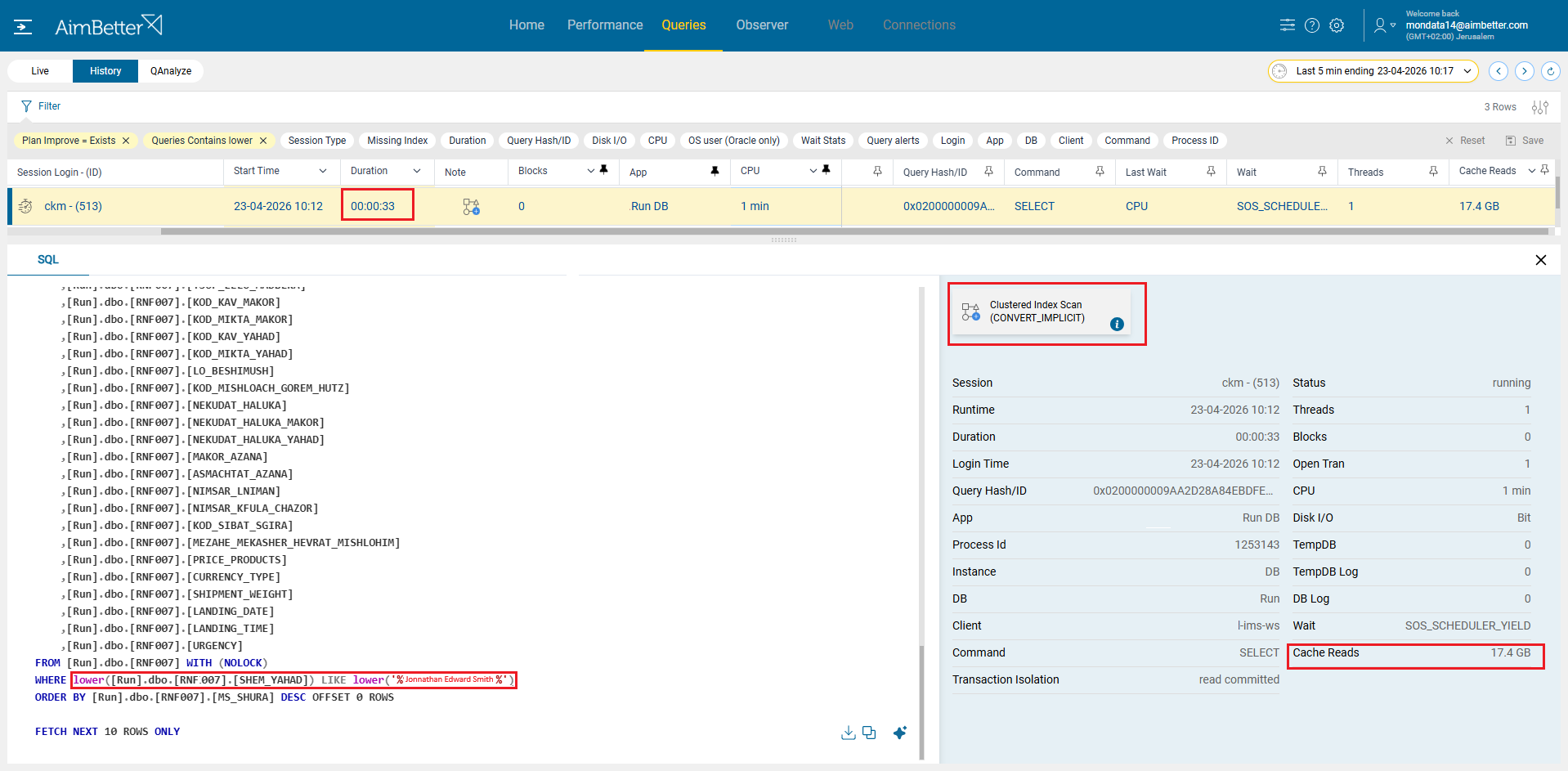
Using AimBetter’s AI analysis, the reason became clear. The query was using a LOWER() function on a column, which forced an Index Scan instead of an Index Seek. On its own, that’s a known inefficiency. But the real breakthrough wasn’t just the pattern — it was the timing. The query appeared for the first time exactly at 12:00, with no executions in the previous seven days.
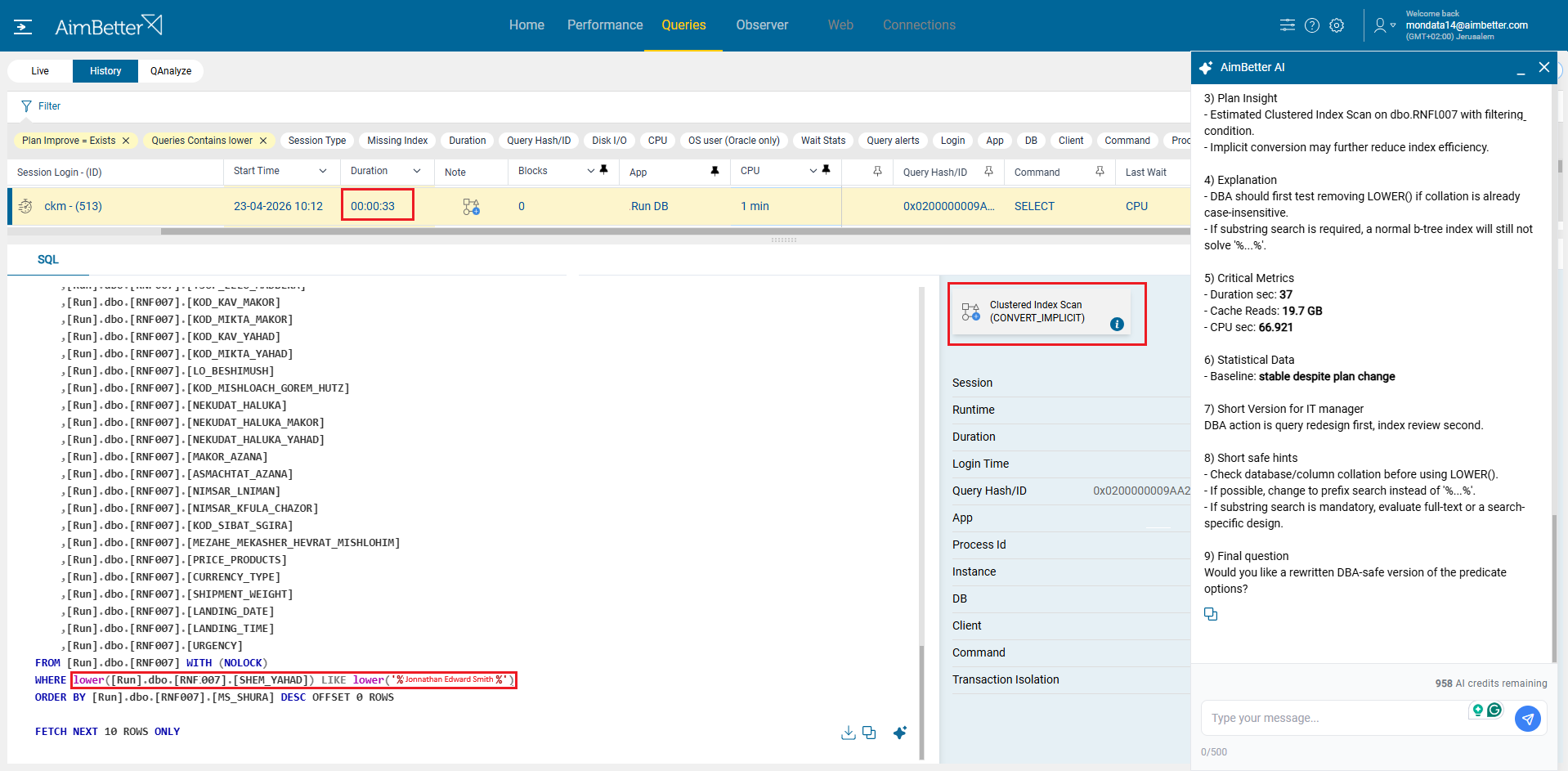
That insight changed everything. Despite the initial claim, something had indeed changed. When we dug deeper, it turned out that developers had been working with cloud-based AI tools. The code looked perfectly fine in the development environment, so it was pushed to production without a second thought. What wasn’t considered was how that small change would behave under real production scale.
There was no dramatic bug and no obvious crash. Just a seemingly minor change, repeated thousands of times, consuming massive resources. And that was enough to bring the entire system down and cause serious financial impact.
Once identified, the resolution was straightforward. The problematic query was fixed by removing the LOWER() usage and aligning the indexing strategy. Almost immediately, system performance stabilized and returned to normal.
The takeaway is clear. In the AI era, development is faster than ever, but so is the introduction of risk. A query doesn’t have to be “slow” to be dangerous. When high frequency meets high resource consumption, even a half-second query can become the root cause of a major outage. Without proper visibility, there is simply no way to react in time.
AimBetter didn’t just detect a problem — it pinpointed the exact moment, the exact query, and the exact reason behind the failure. That level of precision is what turned a crisis into a quick recovery. And in this case, it truly saved the day.