The IT Manager at a retail company started using AimBetter primarily to improve SQL Server performance and gain better visibility into occasional slowdowns users were reporting across sales, inventory, and logistics systems. The focus was simple: make the environment more stable, faster, and easier to manage.
One day, while going through what initially looked like routine monitoring data, he started receiving a sudden wave of alerts: an unusually high number of failed login attempts coming from unknown usernames, along with a stream of change tracking notifications that didn’t match any planned maintenance activity.
At first, it felt like something might be misconfigured or unstable in the environment. But as he looked deeper, the picture quickly became more concerning.
Between 10:44 and 11:16, AimBetter showed a rapid sequence of critical system changes: key services like SQL Server Agent were stopped, other internal services were disabled or switched from automatic to manual, and even security-related components were modified. Shortly after, the host itself was restarted, and a new disk suddenly appeared on the system.
At the same time, the login failures kept increasing in the background, thousands of attempts from unknown accounts hitting the SQL Server environment in a very short period.
Individually, each signal might not have told the full story. But together, they formed a clear pattern of abnormal and coordinated activity.
That’s when it became clear this was no longer a performance issue; it was a security incident unfolding in real time.
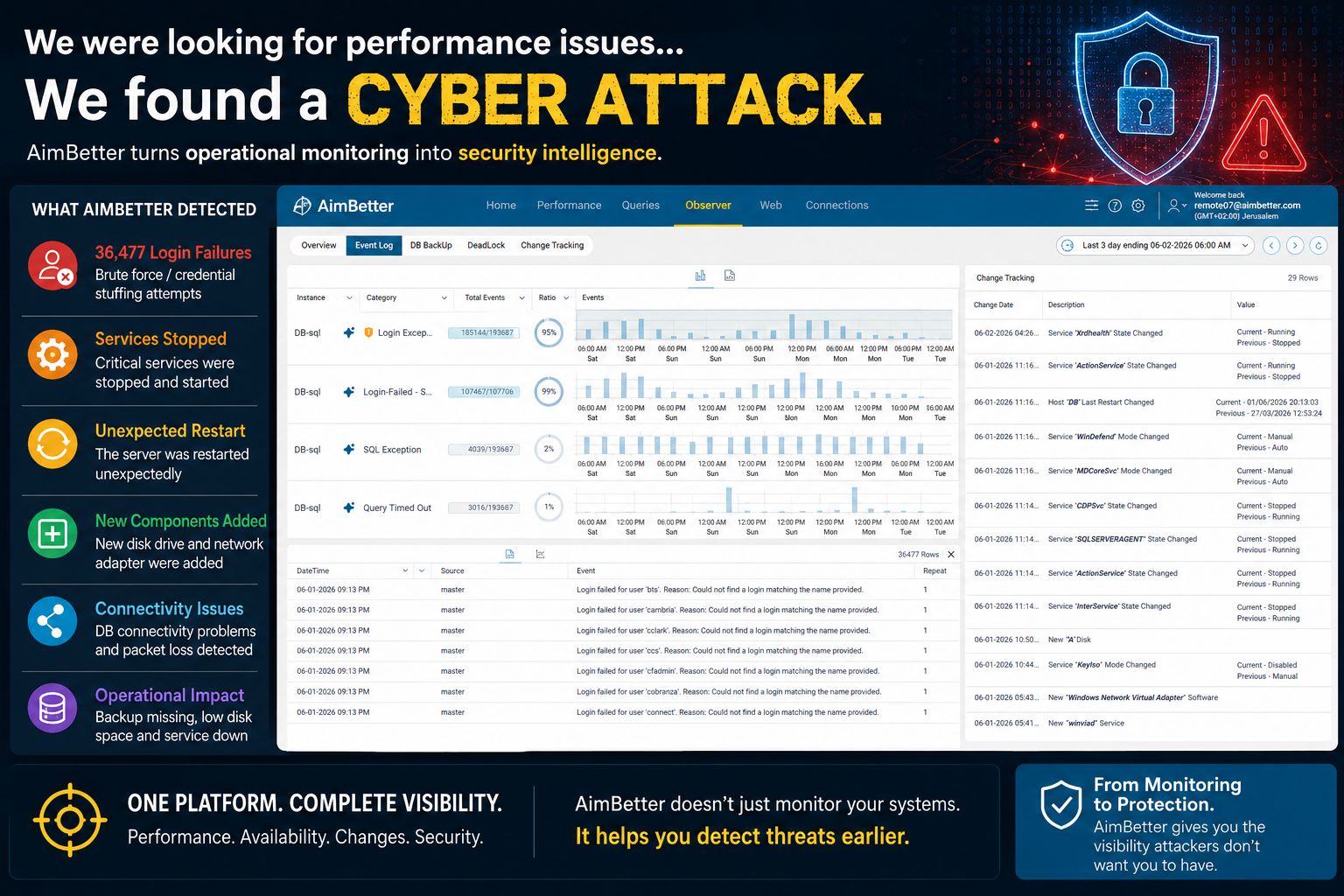
The IT Manager and his team immediately responded by locking down access, restoring critical services, correcting unauthorized changes, and strengthening security configurations across the environment. Malicious activity was blocked, and the system was closely monitored until it stabilized.
By the time things returned to normal, the incident had been contained before it could escalate into a full operational or data security crisis.
What started as a tool for database performance optimization ended up exposing something far more critical: an active cyberattack that would otherwise have blended into everyday system noise.
This case demonstrates how critical infrastructure monitoring can uncover hidden threats. What began as a routine performance investigation revealed a coordinated attack attempt, identified through abnormal system changes and authentication activity. With full visibility across the environment, the IT team was able to respond quickly and prevent a serious security breach.