AimBetter vs Dynatrace
AimBetter receives higher ratings from Capterra and Software Advice than Dynatrace in every category. AimBetter…
Unlike traditional infrastructure monitoring tools, APM platforms, or DBA-focused products, AimBetter was designed to bridge the gap between database performance, operating systems, infrastructure, and operational root-cause analysis. Instead of forcing IT teams to manually correlate data from multiple dashboards and tools, AimBetter delivers a unified operational intelligence layer that helps teams identify and resolve problems faster.
AimBetter’s strongest advantage is its ability to correlate database behavior, query execution, OS resources, and web server activity in a single operational view. This significantly reduces Mean Time To Resolution (MTTR), lowers dependency on specialized DBA troubleshooting, and enables infrastructure and operations teams to quickly isolate production issues before they impact business operations.
AimBetter goes beyond traditional monitoring by not only collecting metrics but also analyzing relationships between databases, operating systems, web servers, and infrastructure layers. This cross-layer visibility helps teams quickly identify the true root cause of performance issues instead of manually correlating information across multiple tools.
AimBetter is designed to reduce the operational burden on DBAs and system administrators. By automatically identifying anomalies, prioritizing critical issues, and surfacing actionable insights, IT teams can resolve incidents faster and spend less time on repetitive diagnostics and manual investigations.
Performance issues and downtime directly impact business productivity. AimBetter helps organizations reduce Mean Time To Resolution (MTTR), minimize service disruptions, and improve system stability — all while lowering operational overhead and simplifying IT monitoring workflows.
Capability |
AimBetter |
Dynatrace |
Datadog |
Redgate Monitor |
SolarWinds |
Mean Time to Root Cause Reduction |
Strong |
Moderate |
Moderate |
Moderate |
Weak |
Cross-Layer Root Cause Correlation |
Strong |
Strong |
Moderate |
Weak |
Weak |
Automatic Identification of DB Bottlenecks |
Strong |
Moderate |
Moderate |
Strong |
Partial |
Actionable Insights vs Raw Metrics |
Strong |
Moderate |
Moderate |
Moderate |
Weak |
Query-to-Infrastructure Correlation |
Strong |
Partial |
Partial |
Weak |
Weak |
Session-Level Operational Analysis |
Strong |
Partial |
Partial |
Strong |
Weak |
Blocking & Deadlock Visualization |
Strong |
Partial |
Partial |
Strong |
Partial |
Historical Incident Reconstruction |
Strong |
Strong |
Moderate |
Moderate |
Partial |
Noise Reduction / Alert Prioritization |
Strong |
Strong |
Moderate |
Weak |
Weak |
Single-Pane Root Cause Analysis |
Strong |
Moderate |
Moderate |
Weak |
Weak |
Time to Initial Value |
Strong |
Weak |
Moderate |
Moderate |
Moderate |
Deployment Complexity |
Low |
High |
High |
Moderate |
High |
Number of Components Required |
Low |
High |
Moderate |
Low |
High |
DBA Dependency Reduction |
Strong |
Moderate |
Weak |
Weak |
Weak |
Learning Curve |
Low |
High |
Moderate |
Moderate |
High |
Operational Overhead |
Low |
High |
Moderate |
Moderate |
High |
Agent Footprint |
Lightweight |
Heavy |
Moderate |
Moderate |
Moderate |
Ease of Installation |
Strong |
Moderate |
Moderate |
Moderate |
Weak |
Maintenance Complexity |
Low |
High |
Moderate |
Moderate |
High |
SLA Protection |
Strong |
Strong |
Moderate |
Moderate |
Moderate |
Downtime Prevention |
Strong |
Strong |
Moderate |
Moderate |
Moderate |
Performance Issue Resolution Speed |
Strong |
Moderate |
Moderate |
Moderate |
Weak |
Business Impact Visibility |
Strong |
Moderate |
Moderate |
Weak |
Weak |
Proactive vs Reactive Operations |
Strong |
Strong |
Moderate |
Moderate |
Weak |
DBA Productivity Improvement |
Strong |
Moderate |
Weak |
Moderate |
Weak |
Infrastructure Cost Optimization Through Diagnosis |
Strong |
Partial |
Partial |
Weak |
Weak |
Requires Deep APM Instrumentation |
No |
Yes |
Yes |
No |
No |
Requires Multiple Modules |
No |
Partial |
Partial |
No |
Yes |
SQL Server Only Focus |
No |
No |
No |
Partial |
No |
Cloud-Native Bias |
No |
Strong |
Strong |
No |
Partial |
Requires Dedicated Monitoring Team |
No |
Often |
Sometimes |
No |
Sometimes |
Tool Fragmentation |
Low |
Moderate |
Moderate |
Low |
High |
Requires Manual Correlation |
Low |
Moderate |
Moderate |
High |
High |
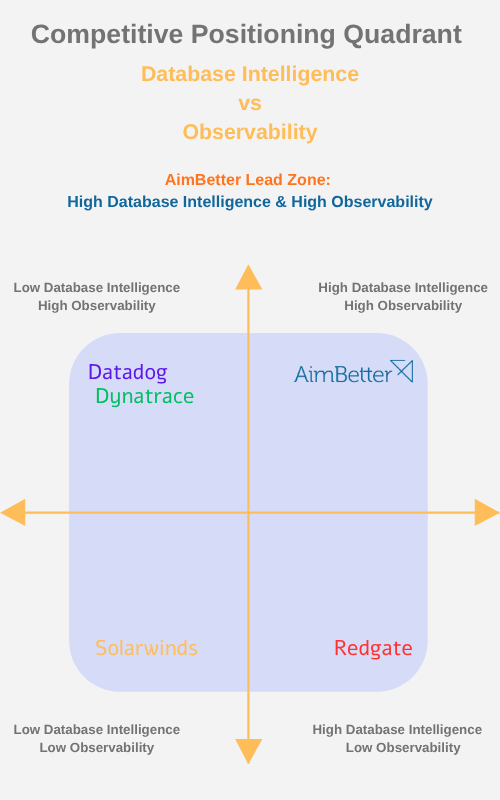
Dynatrace is extremely powerful for application observability, but database execution-level diagnosis often requires deeper investigation and more operational complexity.
Datadog provides broad visibility across systems, but database operational intelligence and root-cause isolation may still require significant manual correlation.
Redgate provides strong SQL diagnostics, but limited infrastructure and cross-layer operational correlation.
SolarWinds often requires multiple modules and operational correlation across tools, which can increase troubleshooting complexity and operational overhead.